Today, we just had a review day for our test on Monday on Atomic Theory and Periodic Table and trends.
Good luck to all!
Thursday, May 12, 2011

Tuesday, May 10, 2011
Electron Dot Diagrams
How to draw them
Drawing electon dot diagrams (or Lewis diagrams) are quite easy if you follow these steps/rules.
1. The nucleus is represented by the atomic symbol
2. Each electron is represented by a dot which are around the atomic symbol
3. There are four orbitals on each side of the nucleus. Each orbit can hold a maximum of 2 electrons
4. 8 electrons represent a closed shell, except for H, which needs 2 electrons to become stable
5. Determine the # of valence electrons
For example sodium is in group 1 therefore it has 1 valence electron
Here are some examples that include double/triple bonding

There are many types of electron diagrams, such as Bohr, Lewis or structural.
In a structural diagram, each bonded pair is represented as a line.
Here's an example:
 Now, if we want to represent ionic bonds, we would look at the charge of the ion. For example, for NaCl:
You would put the negative ion in square brackets, and write the positive ion right beside it. So, you would write Na+ [Cl]- (but you would include dots around the four orbits to symbolize that the compound has satisfied the octet rule).
In Lewis structures, the number of bonds is shown, along with the lone paired electrons, which are electrons that do not participate in sharing.
But how do we determine which element is the central atom?
Here are a few rules to follow:
1. H and F are never in the middle
2. If there is a metal, the metal is always the central one
3. If a molecule contains only one atom of one element, and many of another, then the single atom is in the centre.
4. Atoms that need the most electrons to complete their valence shell is in the centre.
Let's try an example:
C2H2:
First, how many valence electrons do we have?
4x2 + 1x2 = 10
Now, we have two C's in the middle, with a bond in between them.
C - C
Then, we have two H's branching out from the C's.
H - C - C - H
That makes 6 electrons, so we have to distribute 4 more to the C's (since H's are already full)
If we distributed them evenly, we would have two lone electrons on each of the C's. (preferably one on each of the orbits)
Then, if we took one of the electrons and bonded it with an electron from the other C, we would have a double bond between the C's and one lone electron remaining on each C.
Now, if we take those ones and bond them together, we will successfully get our full shell, with a triple bond between the Carbons.
Here's some practice:
http://misterguch.brinkster.net/PRA017.pdf
http://www.arps.org/users/hs/thompsom/honors/chap_07/Lewis_Structure_Worksheet_1.pdf
Drawing electon dot diagrams (or Lewis diagrams) are quite easy if you follow these steps/rules.
1. The nucleus is represented by the atomic symbol
2. Each electron is represented by a dot which are around the atomic symbol
3. There are four orbitals on each side of the nucleus. Each orbit can hold a maximum of 2 electrons
4. 8 electrons represent a closed shell, except for H, which needs 2 electrons to become stable
5. Determine the # of valence electrons
For example sodium is in group 1 therefore it has 1 valence electron
Here are some examples that include double/triple bonding

There are many types of electron diagrams, such as Bohr, Lewis or structural.
In a structural diagram, each bonded pair is represented as a line.
Here's an example:
You would put the negative ion in square brackets, and write the positive ion right beside it. So, you would write Na+ [Cl]- (but you would include dots around the four orbits to symbolize that the compound has satisfied the octet rule).
In Lewis structures, the number of bonds is shown, along with the lone paired electrons, which are electrons that do not participate in sharing.
But how do we determine which element is the central atom?
Here are a few rules to follow:
1. H and F are never in the middle
2. If there is a metal, the metal is always the central one
3. If a molecule contains only one atom of one element, and many of another, then the single atom is in the centre.
4. Atoms that need the most electrons to complete their valence shell is in the centre.
Let's try an example:
C2H2:
First, how many valence electrons do we have?
4x2 + 1x2 = 10
Now, we have two C's in the middle, with a bond in between them.
C - C
Then, we have two H's branching out from the C's.
H - C - C - H
That makes 6 electrons, so we have to distribute 4 more to the C's (since H's are already full)
If we distributed them evenly, we would have two lone electrons on each of the C's. (preferably one on each of the orbits)
Then, if we took one of the electrons and bonded it with an electron from the other C, we would have a double bond between the C's and one lone electron remaining on each C.
Now, if we take those ones and bond them together, we will successfully get our full shell, with a triple bond between the Carbons.
Here's some practice:
http://misterguch.brinkster.net/PRA017.pdf
http://www.arps.org/users/hs/thompsom/honors/chap_07/Lewis_Structure_Worksheet_1.pdf
Monday, May 2, 2011
Bohr Model Diagram
The Bohr model was approximately correct to what we know today, it was close in the theory of quantum mechanics. Bohr proposed that electrons occupied shells, otherwise known as orbitals. He believed that electrons had certain "energy levels", the lowest energy state being the |ground state. Bohr thought that the electron can "jump" to higher levels when they are "excited"and vice versa to when the electrons fall to the lower lessons. He thought that each "jump" or "fall" would give off a quantum of light energy, emitting a spectrum of light.
 In the first shell, only 2 electrons are able to occupy it. The second shell there can be 8 electrons, and the third shell, there can also be 8 electrons, and this is called the octet. Bohr also suggested that electrons were not able to move freely in the atom and that when electrons are heated, they will give off a certain wavelength that is unique for each element.
Bohr also wrote something in the middle of the diagram. He wrote the number of protons and neutrons in the atom. For example, the diagram above is a representation of a Boron atom. The Atomic number is 5, meaning the proton is also 5... So in the middle it says P:5. The atomic number of this element is 10.8, and to get the neutrons you do 10.8-5 which equals 5.8, which is 6 when rounded. There fore you write N:6 in the middle. After drawing the thing in the middle, don't forget to draw the electrons that are in the orbitals. In this case, there are 5 electrons, so you put 2 electrons in the first shell, and 3 in the next.

and... BAYUM u just got yourself a Bohr Model Diagram! how easy was that! YAY! success ^^ WHOOP WHOOP!! :)
For more practice or more knowledge on Bohr Diagrams.. refer to these sites/videos:
http://needham.wikispaces.com/file/view/03+BohrModelPractice.pdf
http://pw.vsb.bc.ca/wyper/sci9/2-3_bohr_diagram_worksheet.pdf
Bohr also wrote something in the middle of the diagram. He wrote the number of protons and neutrons in the atom. For example, the diagram above is a representation of a Boron atom. The Atomic number is 5, meaning the proton is also 5... So in the middle it says P:5. The atomic number of this element is 10.8, and to get the neutrons you do 10.8-5 which equals 5.8, which is 6 when rounded. There fore you write N:6 in the middle. After drawing the thing in the middle, don't forget to draw the electrons that are in the orbitals. In this case, there are 5 electrons, so you put 2 electrons in the first shell, and 3 in the next.
and... BAYUM u just got yourself a Bohr Model Diagram! how easy was that! YAY! success ^^ WHOOP WHOOP!! :)
For more practice or more knowledge on Bohr Diagrams.. refer to these sites/videos:
http://needham.wikispaces.com/file/view/03+BohrModelPractice.pdf
http://pw.vsb.bc.ca/wyper/sci9/2-3_bohr_diagram_worksheet.pdf
Periodic Table Trends
In this blog, we will cover some patterns and trends in the periodic table.
Some of the patterns that we will discuss include
1. Metallic properties
2. Atomic Radius
3. Ionization energy
4. Electronegativity
5. Reactivity
6. Ion charge
7. Melting/boiling point
8. Density
First, let's start with metallic properties.
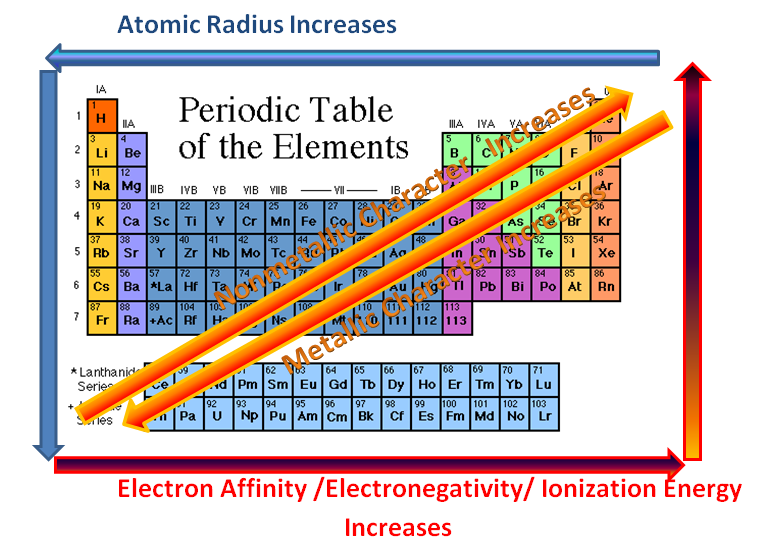
Although this one seems obvious, it is still good to point it out. When moving from left to right in the periodic table, the properties of the elements change from metallic to non-metallic.
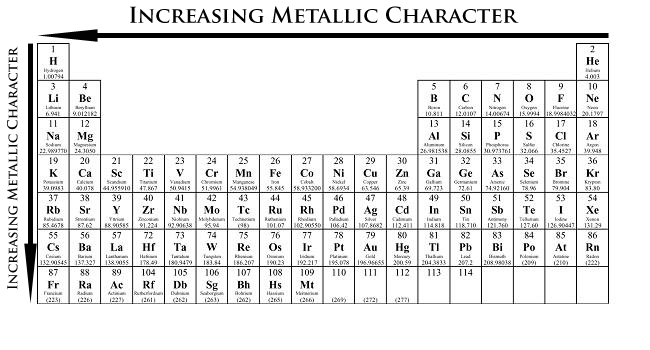
Also, when going down a family (column), elements become more metallic, or better metals.
Secondly, let's study about the atomic radii.
When moving from left to right, the atomic radii decreases. This is because the atomic number and the positive charge increase. The increase in atomic number means an increase in both electrons and protons, making the force of attraction much stronger, and decreasing the distance between each other.
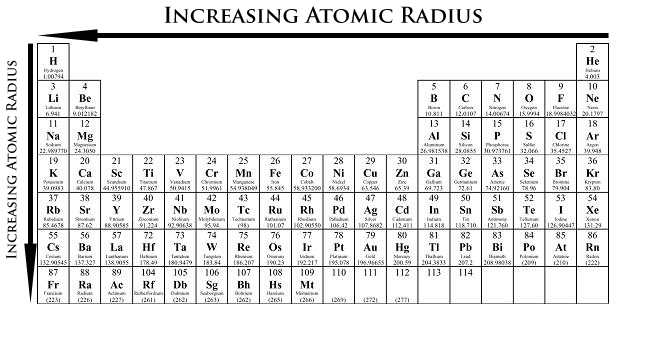
When going from up to down in a column, the radii will increase. This is because there will be more orbits taken up by the electrons. The inner electrons also repel the outer electrons, increasing the distance between the outermost electrons and the nucleus.
To recap atomic radii: left to right, decrease; up to down, increase.
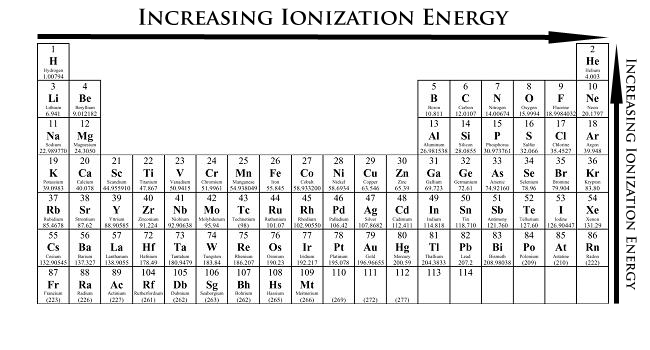
Now, ionization energy. First, let's define the term. Ionization energy is the energy required to remove an electron from the neutral atom. Measured in kJ/mol, IE is basically the opposite of the atomic radius. Helium has the highest IE, and Francium has the lowest IE.
Usually, the outermost electron is removed, and so it should always be a valence electron being removed, unless it is a closed shell.
When moving left to right across a period, ionization energy increases. This is because the radii has been decreased, meaning a very strong attraction between the electrons and the nucleons (protons and neutrons). This means that it will be harder to remove an electron.
When moving up to down, the ionization energy decreases due to a larger radius. Attraction between the nucleus and the outer electrons is also decreased because there are more orbits in between blocking the way.
We can refer to removing the first electron as the first ionization energy, and removing the second as second ionization energy, etc.
Number 4, electronegativity. Definition: how much atoms want to gain electrons, or tendency to attract electrons from a neighbouring atom.
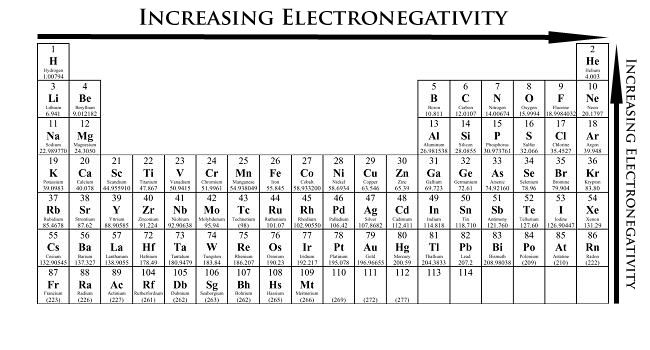
This means that if an atom has high electronegativity, it strongly attracts electrons from a neighbouring atom, and could almost "steal" an electron from its neighbour. As well, this means that the atom has a strong attraction with its valence electrons, so the electrons are harder to remove and thus has a higher ionization energy.
In the same way, lower electronegativity = lower ionization energy, because the atom does not have a strong attraction with its own valence electrons, then electrons are easier to remove.
The top right (Fluorine), except for noble gases, has the highest electronegativity.
To recap: left to right, increase in electronegativity; up to down, decrease in electronegativity.
5. Reactivity
In metals:
left to right, decreases
up to down, increases, because it is easier for electrons to be given away, meaning higher reactivity.
In non-metals, left to right, increase
up to down, decreases, because non-metals have higher electronegativity.
6. Ion Charge
The charges depend on its group.
For example,
group 1, +
group 2, 2+
group 13, 3+
group 14, 4+
group 15, 3-
group 16, 2-
group 17, 1-
group 18, 0
In the transition metals, the charges are variable.
7. Melting/boiling point
The noble gases have the lowest melting points, and the elements in the center have the highest. Melting point increases from left to right, except for in the middle.
In metals, going down the group decreases the melting and boiling points.
In non-metals, going down the group increases the melting and boiling points.
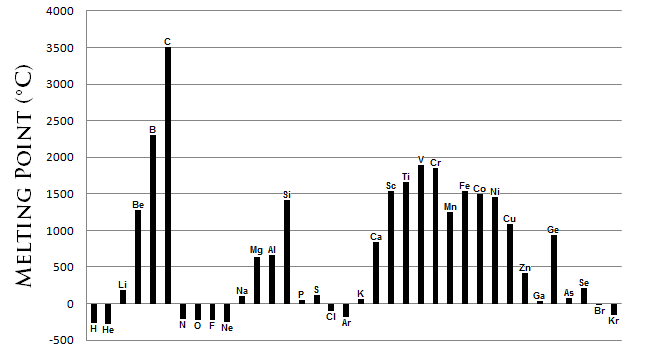
8. Density
As you go down a group in the periodic table, density increases. This is because, as you go down, atomic radius increases, and volume increases, so it will be more dense.
In summary,
http://mysite.oswego308.org/schools/uploads/files/3231/ws_periodic_table_and_trends.pdf
http://butane.chem.uiuc.edu/cyerkes/Chem102AEFa07/worksheets/Worksheet%2012.pdf
Some of the patterns that we will discuss include
1. Metallic properties
2. Atomic Radius
3. Ionization energy
4. Electronegativity
5. Reactivity
6. Ion charge
7. Melting/boiling point
8. Density
First, let's start with metallic properties.
Although this one seems obvious, it is still good to point it out. When moving from left to right in the periodic table, the properties of the elements change from metallic to non-metallic.

Also, when going down a family (column), elements become more metallic, or better metals.
Secondly, let's study about the atomic radii.
When moving from left to right, the atomic radii decreases. This is because the atomic number and the positive charge increase. The increase in atomic number means an increase in both electrons and protons, making the force of attraction much stronger, and decreasing the distance between each other.

When going from up to down in a column, the radii will increase. This is because there will be more orbits taken up by the electrons. The inner electrons also repel the outer electrons, increasing the distance between the outermost electrons and the nucleus.
To recap atomic radii: left to right, decrease; up to down, increase.
Now, ionization energy. First, let's define the term. Ionization energy is the energy required to remove an electron from the neutral atom. Measured in kJ/mol, IE is basically the opposite of the atomic radius. Helium has the highest IE, and Francium has the lowest IE.

Usually, the outermost electron is removed, and so it should always be a valence electron being removed, unless it is a closed shell.
When moving left to right across a period, ionization energy increases. This is because the radii has been decreased, meaning a very strong attraction between the electrons and the nucleons (protons and neutrons). This means that it will be harder to remove an electron.
When moving up to down, the ionization energy decreases due to a larger radius. Attraction between the nucleus and the outer electrons is also decreased because there are more orbits in between blocking the way.
We can refer to removing the first electron as the first ionization energy, and removing the second as second ionization energy, etc.
Number 4, electronegativity. Definition: how much atoms want to gain electrons, or tendency to attract electrons from a neighbouring atom.

This means that if an atom has high electronegativity, it strongly attracts electrons from a neighbouring atom, and could almost "steal" an electron from its neighbour. As well, this means that the atom has a strong attraction with its valence electrons, so the electrons are harder to remove and thus has a higher ionization energy.
In the same way, lower electronegativity = lower ionization energy, because the atom does not have a strong attraction with its own valence electrons, then electrons are easier to remove.
The top right (Fluorine), except for noble gases, has the highest electronegativity.
To recap: left to right, increase in electronegativity; up to down, decrease in electronegativity.
5. Reactivity
In metals:
left to right, decreases
up to down, increases, because it is easier for electrons to be given away, meaning higher reactivity.
In non-metals, left to right, increase
up to down, decreases, because non-metals have higher electronegativity.
6. Ion Charge
The charges depend on its group.
For example,
group 1, +
group 2, 2+
group 13, 3+
group 14, 4+
group 15, 3-
group 16, 2-
group 17, 1-
group 18, 0
In the transition metals, the charges are variable.
7. Melting/boiling point
The noble gases have the lowest melting points, and the elements in the center have the highest. Melting point increases from left to right, except for in the middle.
In metals, going down the group decreases the melting and boiling points.
In non-metals, going down the group increases the melting and boiling points.

8. Density
As you go down a group in the periodic table, density increases. This is because, as you go down, atomic radius increases, and volume increases, so it will be more dense.
In summary,

http://mysite.oswego308.org/schools/uploads/files/3231/ws_periodic_table_and_trends.pdf
http://butane.chem.uiuc.edu/cyerkes/Chem102AEFa07/worksheets/Worksheet%2012.pdf
Thursday, April 28, 2011
Quiz day and Periodic Table studying
Today, we had a short quiz on Atomic Theory and Electron Configuration. Then, we headed to the Curriculum Lab to study some trends in the Periodic Table.

We were given information about each element, such as density, melting/boiling points, ionization energy, electronegativity, and atomic radius, and we were to graph the properties and determine general trends found in the periodic table.
We will discuss these trends in our next blog! :)
Here is a good website to check out if you want to go ahead and look at some periodic trends!
http://www.chemguide.co.uk/atoms/propsmenu.html#top
Tuesday, April 26, 2011
Predicting Valence Electrons
Valence electrons are located in the outermost open shell of an electron. These take part in chemical reactions.
What we mean by open shell is that the shell contains less than the maximum number of electrons.
In contrast, a closed shell would be completely full.
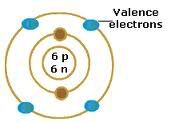
The valence electrons are all the electrons in the atom except in core and filled d/f subshells. In other words, the valence electrons are the s, p types of the outer set, and ONLY unfilled d and f subshells.
For example, if we were given the configuration of Calcium as:
1s2 2s2 2p6 3s2 3p6 4s2
To see the valence electrons easier, put that configuration in Core Notation:
[Ar] 4s2
We see there are only 2 electrons in the outer set, and they meet the rules, since it is an s-subshell.
For a harder one, let's do Pb.
[Xe] 6s2 4f14 5d10 6p2
How many valence electrons are there?
If you got 4, you are correct. This is because there are 2 from the s-subshell, and 2 from the p-subshell. We do not count the f and d, because they are FILLED.
And that is all for this short section! :)
What we mean by open shell is that the shell contains less than the maximum number of electrons.
In contrast, a closed shell would be completely full.

The valence electrons are all the electrons in the atom except in core and filled d/f subshells. In other words, the valence electrons are the s, p types of the outer set, and ONLY unfilled d and f subshells.
For example, if we were given the configuration of Calcium as:
1s2 2s2 2p6 3s2 3p6 4s2
To see the valence electrons easier, put that configuration in Core Notation:
[Ar] 4s2
We see there are only 2 electrons in the outer set, and they meet the rules, since it is an s-subshell.
For a harder one, let's do Pb.
[Xe] 6s2 4f14 5d10 6p2
How many valence electrons are there?
If you got 4, you are correct. This is because there are 2 from the s-subshell, and 2 from the p-subshell. We do not count the f and d, because they are FILLED.
And that is all for this short section! :)
History of the Periodic Table
In 1863-1866, John Newlands found that every eighth element, starting with hydrogen first, shared a common set of properties.
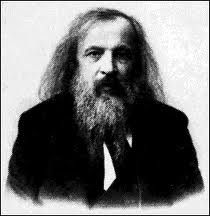
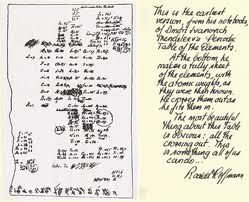
In 1869, Dmitri Mendeleev listed the elements according to the masses and showed that certain properties recur, breaking the list into rows (periods) and columns (groups). He left gaps in his periodic table, and suggested those elements had yet to be discovered. He could also predict the properties and characteristics of these undiscovered elements.
Now, the modern periodic table is organized in atomic number. The Periodic Law suggests that properties of elements recur periodically when elements are arranged in atomic number.
The families (or groups or columns) include:
Alkali metal, alkaline earth metals, halogens, and noble gases.
The rows underneath the table are called Lanthanides (starting with Lanthanum) and Actinides (starting with Actinium). These rows are considered as inner transition metals. The main transition metals are in between the metals and non-metals, and the staircase starting in group 3 signifies metalloids, which have both metal and non-metal properties.
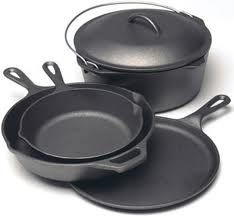
Metals are opaque and shiny. They are good conductors of heat and electricity, and can be hammered into sheets (malleable) or drawn into wires (ductile). They are usually solids at room temperature (with Mercury being the exception), and they tend to lose electrons.
Non-metals are gases and liquids at room temperature. They are poor conductors of heat and electricity. Some non-metals are brittle solids, and are dull in appearance and opaque.

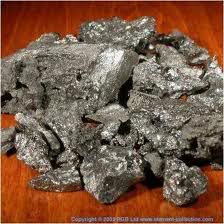
Semiconductors are non-metals with electric conductivity. They are also called metalloids, and their properties resemble metals more than non-metals. The difference is that metal conductivity decreases with increasing temperature, but semiconductor conductivity increases with increasing temperature.
Here's another summary:
http://hyperphysics.phy-astr.gsu.edu/hbase/pertab/metal.html

In 1869, Dmitri Mendeleev listed the elements according to the masses and showed that certain properties recur, breaking the list into rows (periods) and columns (groups). He left gaps in his periodic table, and suggested those elements had yet to be discovered. He could also predict the properties and characteristics of these undiscovered elements.


Now, the modern periodic table is organized in atomic number. The Periodic Law suggests that properties of elements recur periodically when elements are arranged in atomic number.
The families (or groups or columns) include:
Alkali metal, alkaline earth metals, halogens, and noble gases.
The rows underneath the table are called Lanthanides (starting with Lanthanum) and Actinides (starting with Actinium). These rows are considered as inner transition metals. The main transition metals are in between the metals and non-metals, and the staircase starting in group 3 signifies metalloids, which have both metal and non-metal properties.
Metals are opaque and shiny. They are good conductors of heat and electricity, and can be hammered into sheets (malleable) or drawn into wires (ductile). They are usually solids at room temperature (with Mercury being the exception), and they tend to lose electrons.

Non-metals are gases and liquids at room temperature. They are poor conductors of heat and electricity. Some non-metals are brittle solids, and are dull in appearance and opaque.

Semiconductors are non-metals with electric conductivity. They are also called metalloids, and their properties resemble metals more than non-metals. The difference is that metal conductivity decreases with increasing temperature, but semiconductor conductivity increases with increasing temperature.

Here's another summary:
http://hyperphysics.phy-astr.gsu.edu/hbase/pertab/metal.html
Subscribe to:
Posts (Atom)